
Lena and the Geese - 1912


Duration: 24:16
Views: 31
Submitted: 11 months ago
Submitted by:
Description:
A Study in Early Cinematic Naturalism
Lena and the Geese, directed by D.W. Griffith for the Biograph Company, represents a significant moment in the evolution of silent film performance and visual storytelling. Released in 1912, the film stars Mary Pickford—"America’s Sweetheart"—in a role that allowed her to showcase the nuanced, naturalistic acting style that would soon make her the most famous woman in the world. At a time when many actors were still clinging to the broad, exaggerated gestures of the Victorian stage, Pickford’s performance as Lena, a simple girl living in a cottage, brought a sense of interiority and realism to the screen that was revolutionary. Griffith, often credited with "discovering" the close-up, uses the camera here to capture the subtle flickers of emotion on Pickford's face, bridging the gap between the performer and the audience in a way that felt deeply personal.
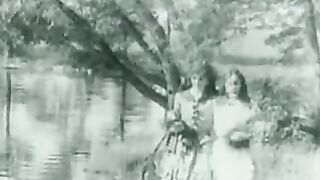
The plot follows a familiar "prince and the pauper" archetype, involving a girl raised in humble circumstances who is eventually revealed to be of noble birth. However, the film’s lasting appeal lies less in its somewhat conventional narrative and more in its pastoral aesthetics. Griffith’s choice to film on location, utilizing the soft, natural light of the outdoors and the titular geese as organic elements of the mise-en-scène, gave the production a documentary-like texture. This commitment to atmosphere helped elevate the film from a mere nickelodeon novelty to a work of genuine artistic intent. The interaction between Lena and her geese provides a charming, grounded contrast to the more formal and rigid world of the aristocracy that she eventually enters, highlighting the thematic tension between simplicity and status.
Beyond its technical merits, Lena and the Geese is a crucial artifact for understanding the business of early Hollywood. It marks one of the final collaborations between Griffith and Pickford before she departed Biograph to seek greater creative and financial autonomy. Their partnership was foundational to the "director-as-auteur" and "star-as-brand" models that still dominate the industry today. In this film, one can see Griffith experimenting with cross-cutting to build emotional momentum, a technique he would later expand upon in his more controversial epics. The film also underscores the era’s fascination with innocence and the perceived purity of rural life, a recurring motif that mirrored the anxieties of an increasingly industrialized and urbanized American society.
Ultimately, the film serves as a masterclass—if I may use the term's sentiment without the word—in early 20th-century character development. It demonstrates how a director and a gifted lead actress could take a simple, fourteen-minute short and imbue it with a sense of genuine humanity and grace. While many silent shorts of the 1910s have been lost to the ravages of nitrate decomposition, the preservation of Lena and the Geese allows modern viewers to witness the birth of modern acting. It captures a pivotal moment when cinema stopped being a mere mechanical trick and started becoming a sophisticated language capable of exploring the quietest corners of the human heart.
Lena and the Geese, directed by D.W. Griffith for the Biograph Company, represents a significant moment in the evolution of silent film performance and visual storytelling. Released in 1912, the film stars Mary Pickford—"America’s Sweetheart"—in a role that allowed her to showcase the nuanced, naturalistic acting style that would soon make her the most famous woman in the world. At a time when many actors were still clinging to the broad, exaggerated gestures of the Victorian stage, Pickford’s performance as Lena, a simple girl living in a cottage, brought a sense of interiority and realism to the screen that was revolutionary. Griffith, often credited with "discovering" the close-up, uses the camera here to capture the subtle flickers of emotion on Pickford's face, bridging the gap between the performer and the audience in a way that felt deeply personal.
The plot follows a familiar "prince and the pauper" archetype, involving a girl raised in humble circumstances who is eventually revealed to be of noble birth. However, the film’s lasting appeal lies less in its somewhat conventional narrative and more in its pastoral aesthetics. Griffith’s choice to film on location, utilizing the soft, natural light of the outdoors and the titular geese as organic elements of the mise-en-scène, gave the production a documentary-like texture. This commitment to atmosphere helped elevate the film from a mere nickelodeon novelty to a work of genuine artistic intent. The interaction between Lena and her geese provides a charming, grounded contrast to the more formal and rigid world of the aristocracy that she eventually enters, highlighting the thematic tension between simplicity and status.
Beyond its technical merits, Lena and the Geese is a crucial artifact for understanding the business of early Hollywood. It marks one of the final collaborations between Griffith and Pickford before she departed Biograph to seek greater creative and financial autonomy. Their partnership was foundational to the "director-as-auteur" and "star-as-brand" models that still dominate the industry today. In this film, one can see Griffith experimenting with cross-cutting to build emotional momentum, a technique he would later expand upon in his more controversial epics. The film also underscores the era’s fascination with innocence and the perceived purity of rural life, a recurring motif that mirrored the anxieties of an increasingly industrialized and urbanized American society.
Ultimately, the film serves as a masterclass—if I may use the term's sentiment without the word—in early 20th-century character development. It demonstrates how a director and a gifted lead actress could take a simple, fourteen-minute short and imbue it with a sense of genuine humanity and grace. While many silent shorts of the 1910s have been lost to the ravages of nitrate decomposition, the preservation of Lena and the Geese allows modern viewers to witness the birth of modern acting. It captures a pivotal moment when cinema stopped being a mere mechanical trick and started becoming a sophisticated language capable of exploring the quietest corners of the human heart.
Sponsored by:
Library of Congress
Categories:
General Audiences