
Dementia - 1955


Duration: 55:18
Views: 2.0K
Submitted: 11 months ago
Submitted by:
Description:
John Parker’s Dementia (1955), also known by its later title Daughter of Horror, is one of the most singular and avant-garde entries in the history of American independent cinema. It is a film that defies standard categorization, existing at the haunting intersection of film noir, German Expressionism, and surrealist nightmare. Stripped entirely of dialogue and told through a combination of a jarring musical score and vivid, distorted imagery, the narrative follows a nameless young woman—credited simply as "The Gamine"—as she wanders through the seedy underbelly of a midnight cityscape. Her journey is a descent into a psychological purgatory where the boundaries between her traumatic memories, her violent impulses, and her waking reality have completely dissolved.
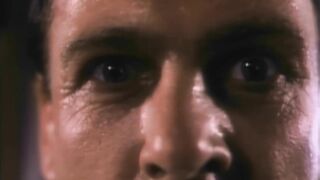
The film’s visual language is its primary narrator, utilizing chiaroscuro lighting to an almost obsessive degree. The streets are depicted as a labyrinth of deep shadows and harsh, flickering neon, populated by grotesque archetypes: the abusive father, the leering drunk, and the skeletal flower girl. Cinematographer William C. Thompson, who worked frequently with Ed Wood, here achieves a level of high-art stylization that is genuinely unsettling. The camera often adopts a Dutch angle or an extreme close-up to emphasize the Gamine’s fracturing sanity, making the viewer a direct participant in her paranoia. This aesthetic brilliance turns the urban environment into a character in itself—a predatory, unblinking witness to the protagonist's spiraling mental state.
One of the most remarkable aspects of the film is its auditory landscape. In the original version, the absence of speech is filled by a chilling, atmospheric score by George Antheil, featuring the wordless, ethereal vocals of Marni Nixon. This creates a "silent movie" feel that is simultaneously modern and ancient, forcing the audience to interpret the Gamine’s internal world through her expressive, often terrified face. When the film was re-released with narration by Ed McMahon, it arguably lost some of its primal power; the original, wordless cut remains the definitive experience. It captures a sense of "inner space" horror that predates the psychological depth of films like Repulsion or Eraserhead, suggesting that the most terrifying monsters are the repressed memories we carry in the dark corners of our minds.
Ultimately, Dementia is a bold, uncompromising work of art that was famously banned and censored upon its initial release for being "dehumanizing" and "obscene." However, viewed today, it stands as a visionary exploration of trauma and the female psyche. It is a poem of madness that manages to be both beautiful and repulsive, using the tropes of the crime thriller to tell a much deeper story about the fragility of the human soul. By the time the film reaches its ambiguous, cyclical conclusion, it has left an indelible mark on the viewer. It remains a essential piece of cult cinema, proving that the most profound cinematic experiences often happen when we stop talking and start looking into the abyss.
The film’s visual language is its primary narrator, utilizing chiaroscuro lighting to an almost obsessive degree. The streets are depicted as a labyrinth of deep shadows and harsh, flickering neon, populated by grotesque archetypes: the abusive father, the leering drunk, and the skeletal flower girl. Cinematographer William C. Thompson, who worked frequently with Ed Wood, here achieves a level of high-art stylization that is genuinely unsettling. The camera often adopts a Dutch angle or an extreme close-up to emphasize the Gamine’s fracturing sanity, making the viewer a direct participant in her paranoia. This aesthetic brilliance turns the urban environment into a character in itself—a predatory, unblinking witness to the protagonist's spiraling mental state.
One of the most remarkable aspects of the film is its auditory landscape. In the original version, the absence of speech is filled by a chilling, atmospheric score by George Antheil, featuring the wordless, ethereal vocals of Marni Nixon. This creates a "silent movie" feel that is simultaneously modern and ancient, forcing the audience to interpret the Gamine’s internal world through her expressive, often terrified face. When the film was re-released with narration by Ed McMahon, it arguably lost some of its primal power; the original, wordless cut remains the definitive experience. It captures a sense of "inner space" horror that predates the psychological depth of films like Repulsion or Eraserhead, suggesting that the most terrifying monsters are the repressed memories we carry in the dark corners of our minds.
Ultimately, Dementia is a bold, uncompromising work of art that was famously banned and censored upon its initial release for being "dehumanizing" and "obscene." However, viewed today, it stands as a visionary exploration of trauma and the female psyche. It is a poem of madness that manages to be both beautiful and repulsive, using the tropes of the crime thriller to tell a much deeper story about the fragility of the human soul. By the time the film reaches its ambiguous, cyclical conclusion, it has left an indelible mark on the viewer. It remains a essential piece of cult cinema, proving that the most profound cinematic experiences often happen when we stop talking and start looking into the abyss.
Categories:
General Audiences