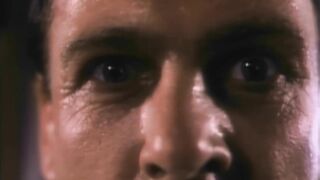

The Cosmonaut - 2013


Duration: 1:41:48
Views: 91
Submitted: 13 hours ago
Submitted by:
Description:
Nicolas Alcalá’s The Cosmonaut (2013) is perhaps more famous for its revolutionary production model than for its actual narrative, standing as a landmark in the history of "crowd-sourced" cinema. Produced by Riot Cinema in Spain, the film was funded by thousands of small donors and released under a Creative Commons license, allowing the public to remix, share, and engage with the material in unprecedented ways. Set against the backdrop of the 1960s Space Race, the story centers on a fictional Soviet mission to the moon. When the cosmonaut Stas (Leon Ockenden) disappears during the mission and later returns to an Earth that seems completely deserted, the film shifts from a historical drama into a lyrical, non-linear exploration of memory, loss, and the nature of reality. It is less a traditional sci-fi thriller and more a visual poem about three friends—Stas, Andrei, and Yulia—caught in a triangle of unrequited love and cosmic isolation.
The film’s greatest strength lies in its stunning cinematography and atmospheric sound design, which evoke a sense of profound loneliness and "Ostalgie" (nostalgia for the East). The visual style borrows heavily from the meditative pacing of Andrei Tarkovsky, particularly Solaris, utilizing long takes, textured close-ups, and a muted color palette to blur the lines between the harsh reality of the Star City training facilities and the ethereal, potentially supernatural experiences of the protagonist. Because the narrative is told through fragmented flashbacks, radio transmissions, and abstract sequences, it requires a significant amount of patience from the viewer. It doesn't offer easy answers regarding whether Stas is in a parallel dimension, experiencing a psychological breakdown, or if the world has truly moved on without him; instead, it prioritizes the emotional truth of his disconnection from the people he loves.
While the film itself received mixed reviews for its somewhat opaque and over-stylized storytelling, the "Cosmonaut experience" extended far beyond the feature-length movie. The creators produced over 30 "webisodes," a book, and an extensive digital archive that filled in the narrative gaps, creating a transmedia universe that rewarded deep dives. This fragmented approach reflected the protagonist's own fractured psyche, but it also meant that the standalone film could feel incomplete to a casual observer. The performances are understated and soulful, particularly Katrine De Candole as Yulia, whose presence serves as the gravitational pull for the two men lost in the cold machinery of Soviet ambition.
Ultimately, The Cosmonaut is a fascinating experiment in 21st-century filmmaking that captures the haunting beauty of the "forgotten" era of space exploration. It treats the Space Race not as a series of technical triumphs, but as a backdrop for a deeply human tragedy about the distances we put between ourselves and those we love. Even if the experimental structure occasionally obscures the plot, the film's ambition and its unique place in the history of independent media make it a compelling watch for fans of "slow cinema" and philosophical science fiction. It remains a testament to the idea that with enough communal support, a small team of filmmakers can create a vision as vast and mysterious as the cosmos itself.
The film’s greatest strength lies in its stunning cinematography and atmospheric sound design, which evoke a sense of profound loneliness and "Ostalgie" (nostalgia for the East). The visual style borrows heavily from the meditative pacing of Andrei Tarkovsky, particularly Solaris, utilizing long takes, textured close-ups, and a muted color palette to blur the lines between the harsh reality of the Star City training facilities and the ethereal, potentially supernatural experiences of the protagonist. Because the narrative is told through fragmented flashbacks, radio transmissions, and abstract sequences, it requires a significant amount of patience from the viewer. It doesn't offer easy answers regarding whether Stas is in a parallel dimension, experiencing a psychological breakdown, or if the world has truly moved on without him; instead, it prioritizes the emotional truth of his disconnection from the people he loves.
While the film itself received mixed reviews for its somewhat opaque and over-stylized storytelling, the "Cosmonaut experience" extended far beyond the feature-length movie. The creators produced over 30 "webisodes," a book, and an extensive digital archive that filled in the narrative gaps, creating a transmedia universe that rewarded deep dives. This fragmented approach reflected the protagonist's own fractured psyche, but it also meant that the standalone film could feel incomplete to a casual observer. The performances are understated and soulful, particularly Katrine De Candole as Yulia, whose presence serves as the gravitational pull for the two men lost in the cold machinery of Soviet ambition.
Ultimately, The Cosmonaut is a fascinating experiment in 21st-century filmmaking that captures the haunting beauty of the "forgotten" era of space exploration. It treats the Space Race not as a series of technical triumphs, but as a backdrop for a deeply human tragedy about the distances we put between ourselves and those we love. Even if the experimental structure occasionally obscures the plot, the film's ambition and its unique place in the history of independent media make it a compelling watch for fans of "slow cinema" and philosophical science fiction. It remains a testament to the idea that with enough communal support, a small team of filmmakers can create a vision as vast and mysterious as the cosmos itself.
Categories:
General Audiences