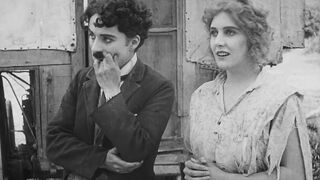

Charlie Chaplin - A Night in the Show - 1915


Duration: 24:57
Views: 73
Submitted: 1 week ago
Submitted by:
Description:
Produced during his transition to the Essanay Film Manufacturing Company, A Night in the Show (1915) is a fascinating, rowdy time capsule that captures Charlie Chaplin revisiting his roots in the British music hall. Unlike his more narrative-driven work, this film is essentially a cinematic recreation of "Mumming Birds" (also known as "A Night in an English Music Hall"), the celebrated stage sketch Chaplin performed while touring with Fred Karno’s troupe. The film is unique for featuring Chaplin in a dual role: he plays Mr. Pest, a rowdy, high-society drunk in the front row, and Mr. Rowdy, a boisterous, working-class drunk in the gallery. This dual performance allows Chaplin to satirize the entire social spectrum of the theater-going public, proving that whether one is in a tuxedo or rags, a gallon of beer is a universal equalizer.
The film's structure is episodic, following a series of increasingly disastrous variety acts—from a tone-deaf singer to a struggling fire-eater—all of which are mercilessly heckled and sabotaged by Chaplin’s two characters. As Mr. Pest, Chaplin displays a sophisticated brand of slapstick, involving a "musical chairs" routine with the theater seats and a hilarious flirtation with a lady that results in him inadvertently ending up in the conductor's pit. As Mr. Rowdy, he leans into a more aggressive, populist humor, eventually turning a fire hose on the performers and the audience alike. This duality is a brilliant display of Chaplin’s range; it showcases his ability to be both the refined, "annoying" gentleman and the chaotic, "destructive" vulgarian, often within the same frame through clever editing.
Visually, the film is more static than his later masterpieces, as it seeks to maintain the "proscenium arch" feel of a real theater. However, the comedy is relentless. One of the standout moments involves a "Snake Charmer" act that goes horribly wrong, leading to a frantic scramble that perfectly captures the unpredictable energy of live vaudeville. The film also features a young Edna Purviance as a disgruntled theater-goer, marking an early appearance in her long and fruitful collaboration with Chaplin. While the film lacks the social commentary or the "Tramp" pathos that would later define his career, it serves as an invaluable record of the slapstick vocabulary Chaplin developed on the stage—the kicks, the trips, and the impeccable "drunk act" that initially made him a star.
Ultimately, A Night in the Show is a loud, chaotic, and joyful celebration of the theater. It offers a rare glimpse into the "pre-Tramp" DNA of Chaplin’s comedy, highlighting his mastery of ensemble timing and his deep understanding of audience psychology. It’s a film that doesn't ask to be taken seriously; instead, it invites the viewer to join in the heckling. For students of comedy, it is a vital document of how stage traditions were translated into the new medium of film, and for fans, it remains a riotous example of Chaplin simply having a grand time breaking the rules of decorum. It’s a rowdy night out at the cinema that still manages to land its punches (and its squirts of water) over a hundred years later.
The film's structure is episodic, following a series of increasingly disastrous variety acts—from a tone-deaf singer to a struggling fire-eater—all of which are mercilessly heckled and sabotaged by Chaplin’s two characters. As Mr. Pest, Chaplin displays a sophisticated brand of slapstick, involving a "musical chairs" routine with the theater seats and a hilarious flirtation with a lady that results in him inadvertently ending up in the conductor's pit. As Mr. Rowdy, he leans into a more aggressive, populist humor, eventually turning a fire hose on the performers and the audience alike. This duality is a brilliant display of Chaplin’s range; it showcases his ability to be both the refined, "annoying" gentleman and the chaotic, "destructive" vulgarian, often within the same frame through clever editing.
Visually, the film is more static than his later masterpieces, as it seeks to maintain the "proscenium arch" feel of a real theater. However, the comedy is relentless. One of the standout moments involves a "Snake Charmer" act that goes horribly wrong, leading to a frantic scramble that perfectly captures the unpredictable energy of live vaudeville. The film also features a young Edna Purviance as a disgruntled theater-goer, marking an early appearance in her long and fruitful collaboration with Chaplin. While the film lacks the social commentary or the "Tramp" pathos that would later define his career, it serves as an invaluable record of the slapstick vocabulary Chaplin developed on the stage—the kicks, the trips, and the impeccable "drunk act" that initially made him a star.
Ultimately, A Night in the Show is a loud, chaotic, and joyful celebration of the theater. It offers a rare glimpse into the "pre-Tramp" DNA of Chaplin’s comedy, highlighting his mastery of ensemble timing and his deep understanding of audience psychology. It’s a film that doesn't ask to be taken seriously; instead, it invites the viewer to join in the heckling. For students of comedy, it is a vital document of how stage traditions were translated into the new medium of film, and for fans, it remains a riotous example of Chaplin simply having a grand time breaking the rules of decorum. It’s a rowdy night out at the cinema that still manages to land its punches (and its squirts of water) over a hundred years later.
Categories:
General Audiences